
These white paper templates help you plan a document that explains a problem, examines evidence and supports a reasoned recommendation. One download provides the argument structure; the other maps claims to sources and identifies research gaps. Both are editable Word planning documents.
Use them before polishing a long report. A well-designed cover cannot compensate for an unclear question or unsupported conclusion. The planning files help you decide what the reader needs, what the evidence shows and which next step the document can reasonably support.
Jump to the downloadable templates
Decide what the paper should help the reader do
Write the intended reader and decision at the top of the plan. A paper for a technical team comparing implementation approaches needs different background from one for a manager deciding whether to investigate a problem further. Define the knowledge the reader can reasonably be expected to have.
Frame a question narrow enough to answer. “How can we improve customer service?” may be too broad for one paper. “Which approach should a small support team test to reduce repeated onboarding questions?” gives the research and recommendation a clearer scope.
Identify the boundaries as well as the purpose. State which users, process or period the paper covers and what it does not examine. This helps prevent a limited finding from turning into a claim about every customer or organization.
Use an outline template if you need an initial list of ideas. Then use the white paper structure to connect those ideas into a sequence that supports the defined question.
Choose the structure and evidence planner together
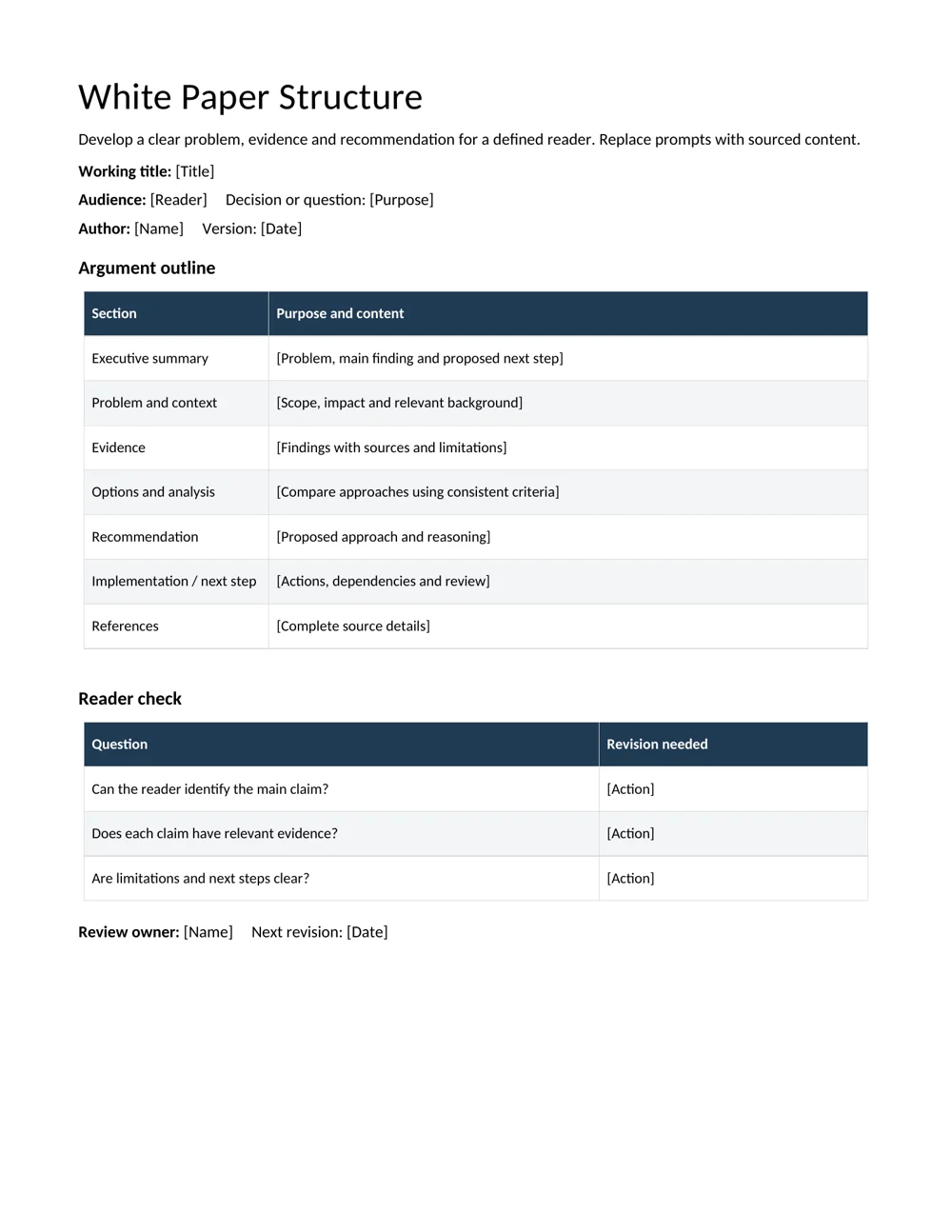
The structure document includes an executive summary, problem and context, evidence, options, recommendation, implementation or next step, and references. Its reader check asks whether the main claim, evidence and limitations are clear. Expand the prompts into the length the subject requires.
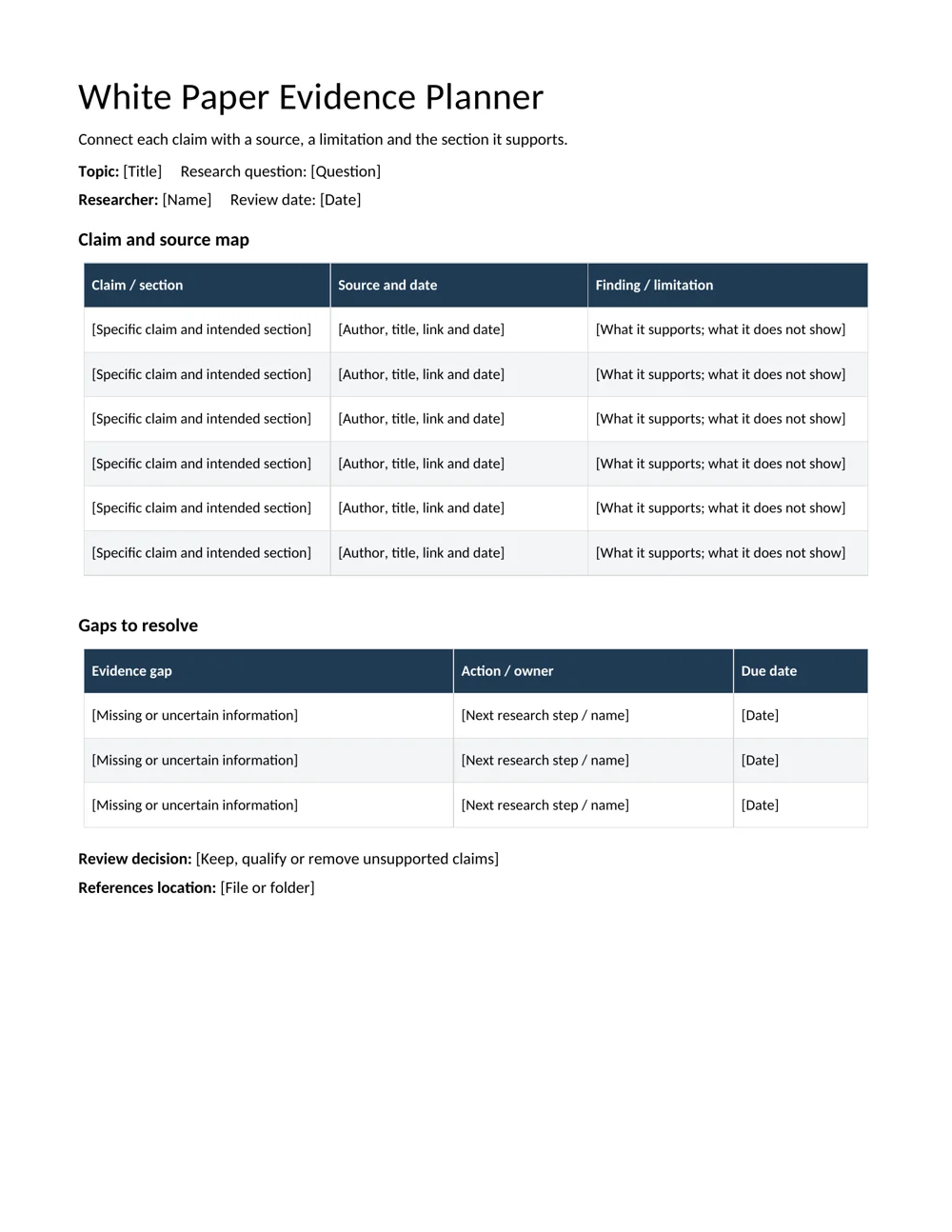
The evidence planner records a specific claim, source details, the finding it supports and a limitation. It also provides a gap list with an owner and due date. This keeps the research connected to the argument rather than becoming an unrelated collection of links.
Start the evidence record while researching, not after drafting. A short note about why a source matters can save time later when several documents discuss similar topics. Record the page, section or other locating detail when it will help you return to the relevant passage.
The files are planning aids rather than a completed research paper or a guarantee of source quality. The writer still needs to inspect the material, interpret it accurately and decide how strongly it supports each claim.
Build a source record you can actually use
For each source, record enough information to identify it again: author or organization, title, publication date, link or location and the relevant section. If the material changes over time, note when you consulted it. Use a consistent reference approach across the finished paper.
Prefer the source that directly contains the relevant finding when it is available. A summary of someone else’s research may omit the conditions or limitations that affect your argument. Read the underlying material rather than treating a search snippet as the complete evidence.
Distinguish measurements, interpretations and proposals in your notes. A report may measure a delay, suggest a cause and recommend a tool. Those are three different statements; the measurement does not automatically prove the proposed cause or the effectiveness of the tool.
Keep exact quotations clearly marked in the research notes so they are not later mistaken for your own draft language. Paraphrase faithfully and attribute borrowed findings. The evidence planner should help preserve the meaning and context, not just provide a link beside a persuasive sentence.
Write the problem before promoting a solution
Explain the current situation in language the intended reader can follow. Describe who encounters the problem, where it appears and what evidence indicates it matters. Avoid opening with a product or process change before the reader understands the question being addressed.
Use concrete examples where they clarify the issue. A recurring onboarding question can be described through the point in the customer journey where it appears. Keep examples distinguishable from measured results, especially when the example is hypothetical.
If the paper refers to a broader initiative, use a project outline to keep scope and deliverables consistent. The paper should not quietly assume a different audience or implementation boundary from the project it is intended to inform.
Check whether the problem statement already assumes the conclusion. “The team needs a new knowledge base” names a possible solution. “Customers repeatedly ask where to find setup instructions” describes a problem that could have several responses. The second framing leaves room to compare those responses fairly.
Worked example: comparing onboarding support options
Imagine a support team considering how to reduce repeated setup questions. Its possible approaches include revising the existing help pages, adding a guided introduction or changing the point where instructions are shared. The paper could compare these approaches against the same criteria.
Relevant evidence might include the questions being asked, the stage at which customers ask them, the maintenance effort and the tools already available. If the team has not tested an approach, label the expected benefit as an expectation rather than reporting it as a result.
The structure could first explain the question pattern, then describe the evidence and its limits, compare the options and recommend a small test. The next step might be a pilot with a defined review point instead of an immediate organization-wide change.
In the evidence planner, “customers cannot find the setup page” requires evidence about finding the page. A record showing that customers ask setup questions supports the existence of questions, but it may not establish why they ask. That distinction can change what the team tests first.
Compare options with consistent criteria
Choose criteria that matter to the stated decision, such as effort, maintenance, accessibility, dependencies and the ability to test the result. Apply them to each realistic option. Avoid describing only the advantages of the preferred approach and only the weaknesses of the alternatives.
Explain what is known and what remains uncertain. One option may require less initial work but more ongoing maintenance. Another may depend on a system change the team does not control. Present those tradeoffs in terms the reader can use.
Do not give invented precision to a judgment. If a score is based on a team discussion, describe the scale and assumptions. A number in a table can look like a measured fact even when it only summarizes a subjective comparison.
Link the recommendation to the criteria and evidence. The reader should be able to follow why the proposed approach fits this question and scope. If important evidence is missing, the appropriate recommendation may be to collect it before choosing an implementation.
Draft the summary after the argument is clear
Write the executive summary once the paper’s reasoning is stable. Summarize the problem, the main finding, the recommendation and the important limitation or next step. A reader should understand the purpose without having to decode a list of section titles.
Keep headings informative. A heading such as “Why customers ask for setup help” tells the reader more than “Discussion.” Use consistent levels so the structure remains easy to scan, and reserve detailed subsections for material that needs them.
Move supporting detail out of the main flow when it interrupts the argument. A long source table may belong in an appendix or research file, while the main paper explains the finding and refers to the evidence. Keep the relationship between the two clear.
Use the checklist templates to organize an editorial pass if several people review the draft. Separate the evidence review from copyediting so a polished sentence is not mistaken for a verified claim.
Review the paper from the reader’s perspective
Ask a reviewer to identify the main question, conclusion and action requested without a verbal explanation from the writer. If those are unclear, revise the structure before spending more time on decorative formatting. A white paper should carry its reasoning on the page.
Check each important claim against the source record. Look for wording that is stronger than the evidence, omitted conditions and outdated information relevant to the subject. Resolve gaps by qualifying, replacing or removing the claim rather than adding a source that does not directly support it.
Review charts, examples and references together with the prose. A table heading can imply a comparison the text never explains. An illustrative example should not appear to be a real customer result, and every referenced attachment should be identifiable.
Save a dated review copy and keep the clean planning templates separate. For a later revision, revisit the evidence and assumptions as well as the wording. Updating a title or date alone does not establish that the paper’s argument remains sound.
Download the 2 editable Word templates
Choose a file below. Each preview shows the supplied layout. Use the download button to open the editable Word document, save a clean master and complete a separate copy.
White Paper Structure
Develop a clear problem, evidence and recommendation for a defined reader. Replace prompts with sourced content.
White Paper Evidence Planner
Connect each claim with a source, a limitation and the section it supports.
Frequently Asked Questions
Are these complete white papers?
No. They are editable planning templates: one for the paper’s structure and one for its evidence. Add your researched content, analysis and references to develop the finished document.
Which file should I start with?
Define the reader and question in the structure template, then use the evidence planner while researching. Move between them as findings change the outline.
How long should a white paper be?
Use the length needed to explain the question, evidence and recommendation clearly. The supplied files do not impose a page count or require unnecessary background.
Can I include a recommendation with incomplete evidence?
Explain the uncertainty and limit the recommendation accordingly. A request for a defined pilot or further research may be more appropriate than a broad implementation claim.
What belongs in the limitations field?
Record what the source or finding does not establish, including a narrow scope or untested explanation. This helps keep the wording of the final claim proportionate.

You must be logged in to post a comment.