
These job description templates help you describe a role clearly before recruitment or an internal review. The role profile format connects responsibilities with expected results. The skills based format adds first-three-month outcomes and evidence for selection criteria. Both downloads are editable Word files.
Begin with the work the organization needs done. A useful description helps applicants judge the role, interviewers assess relevant evidence and a new employee understand what success looks like.
Jump to the downloadable templates
Choose a role profile or a skills based format
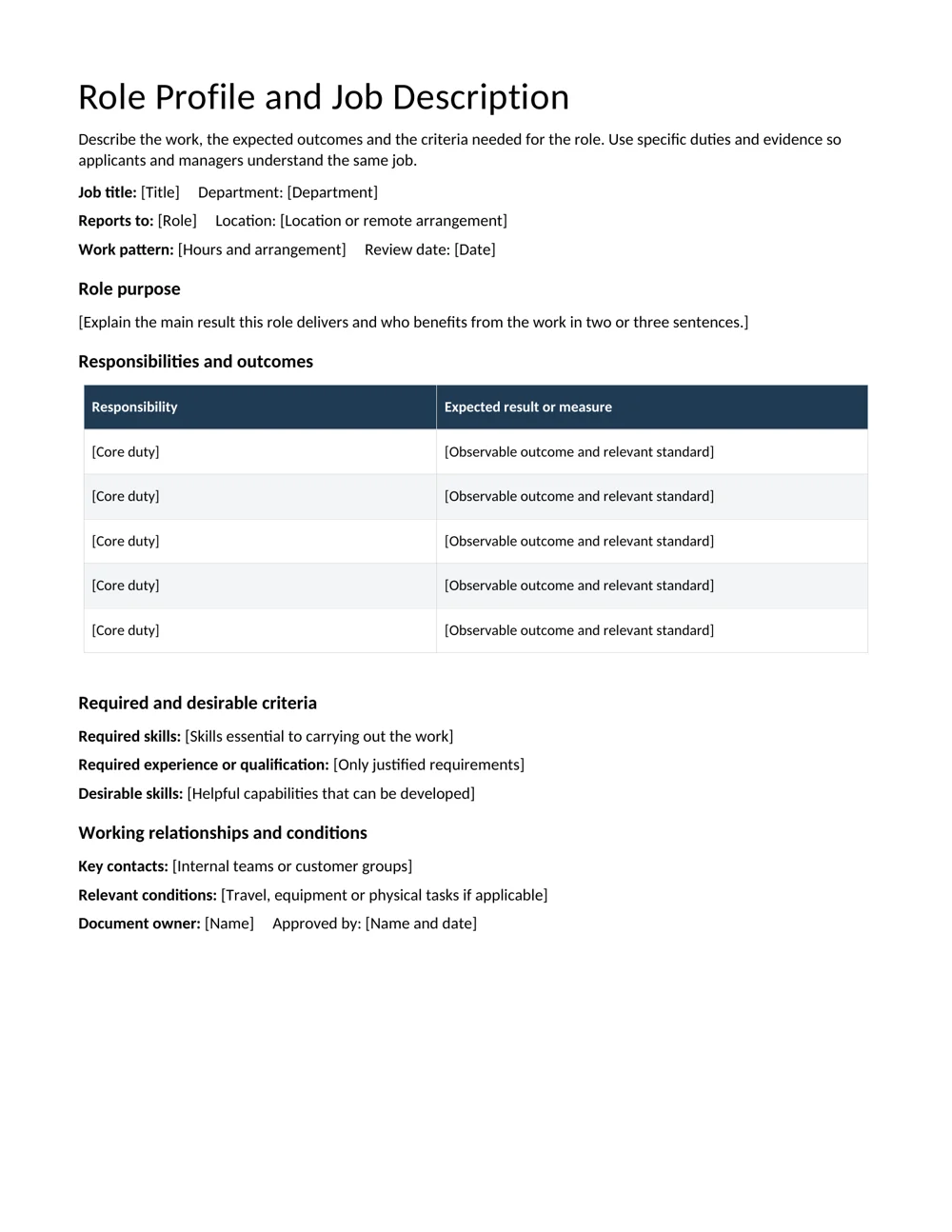
Use the role profile when you need a straightforward summary of purpose, reporting line, core duties, required skills and working relationships. Its responsibility table gives managers a place to state an observable outcome for each duty.
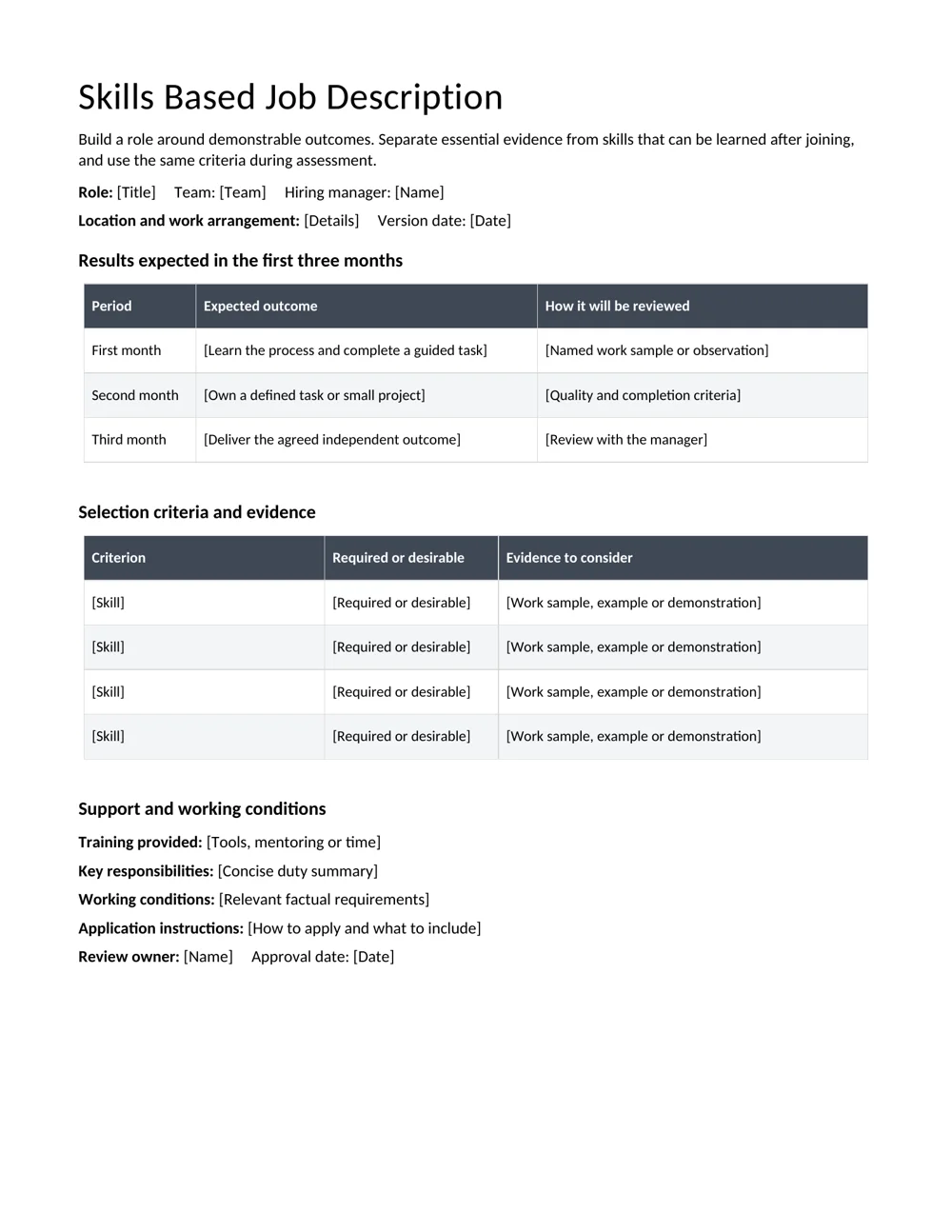
Use the skills based description when you want to make selection criteria and early results more explicit. It separates required and desirable criteria, asks how each will be assessed and records support provided after joining. The first-three-month plan is a discussion framework; adjust the periods and expectations to suit the actual role.
Neither format should be filled by copying a long list from an unrelated vacancy. Ask the manager and people familiar with the work which duties occupy the role, which decisions it owns and where responsibility passes to another team.
Write the purpose and responsibilities
Describe the role purpose in two or three sentences: the work, who benefits and the main result. “Support the operations team by maintaining accurate order records and resolving routine discrepancies” gives more direction than “provide general assistance.”
Start responsibilities with concrete verbs such as prepare, reconcile, schedule, maintain or review. Add the object of the work and a useful standard. Instead of “responsible for communication,” write “send a weekly delivery update to the project team, showing open items and the person handling each one.”
Group related tasks rather than listing every small activity. Explain important decisions, reporting lines and handoffs. If a duty follows a defined method, refer to the relevant standard operating procedure without copying the whole process into the job description.
Separate essential criteria from learnable skills
For each proposed requirement, ask whether the person must already have it to perform the work or could develop it with reasonable training. State the evidence you need rather than adding unexplained years of experience or a qualification unrelated to the duties.
A criterion such as “can reconcile two records and explain a discrepancy” is easier to assess than “excellent attention to detail.” A skills assessment template can help turn the criterion into a consistent work sample or observation.
Keep the description factual and relevant to the role. Explain the actual working arrangement, location, schedule and any important travel or task conditions. Have the appropriate internal reviewer check the wording and any organization-specific requirements before using it in recruitment.
Worked example: operations coordinator
A role purpose could read: “Maintain the order schedule so the delivery team has accurate information and unresolved issues reach the right owner.” Three duties might be updating the daily order list, checking missing delivery details and preparing the weekly exceptions summary.
The expected results can then be written alongside the duties: records are updated by the agreed cut-off, missing information is flagged before handoff, and each open exception has an owner. These are examples to adapt; the manager should confirm realistic standards and the tools available.
For the skills based format, the first month could focus on learning the process and completing supervised updates. The second could cover independent routine updates and clear escalation of exceptions. The third could cover preparing the agreed summary without repeated correction. Identify who will review the work at each stage.
Use the same description during selection and onboarding
Build interview questions around the stated responsibilities and criteria. The job interview question templates can help structure the conversation, but choose questions that test this role’s actual requirements. Keep the assessment criteria consistent across candidates.
Before publishing, check that the title matches the level of responsibility, the reporting line is current, required and desirable criteria are distinct, and applicants know what to submit. Remove every unused bracketed prompt. A description with contradictory hours or an obsolete department name can confuse an otherwise suitable applicant.
After hiring, revisit the same outcomes with the employee. Add a document owner and review date so the role can be updated when responsibilities change. Keep version history and agree changes through the organization’s normal review process rather than silently expanding the role.
Check the boundaries of the role before writing
Ask which work belongs to this role and which belongs to a manager, another team or an external provider. A description that assigns responsibility for a result without giving the person the relevant authority can create confusion after hiring. Record the decisions the person can make and the situations they should escalate.
For the operations coordinator example, the role might update a confirmed delivery date but refer a proposed price change to the manager. Those are different decisions even though both appear in the same order record. Explain the important boundary in plain language rather than using an unexplained phrase such as “full ownership.”
Check the balance between routine tasks and occasional duties. If an infrequent activity is central to the role, explain when it arises. If it is only a possible future idea, do not let it dominate the requirements. Applicants should be able to recognize the work they will actually spend time doing.
Discuss the draft with someone who understands the day-to-day process. They may identify a missing handoff, a tool no longer used or a responsibility that has moved elsewhere. Resolve those points before selection begins, when inconsistent expectations can affect both the applicant experience and the manager’s assessment.
Turn criteria into a consistent assessment plan
Take each essential criterion and decide what evidence would be useful. A work sample, a structured example from experience or a practical explanation may suit different types of work. The job description should not promise one set of criteria while the interview informally rewards unrelated qualities.
For a reconciliation task, a short sample with two records and a difference can show how a candidate checks information and explains an issue. Define what a satisfactory response looks like before reviewing candidates. Consider the accuracy of the check and clarity of explanation rather than whether the person uses exactly the same wording as the manager.
Keep the task proportionate to the role and describe the instructions clearly. If a tool or background fact is necessary to complete it, make that information available. Otherwise, the exercise may test familiarity with an unexplained system rather than the capability named in the description.
Record which criteria are assessed at each stage so the same evidence is not repeatedly requested without purpose. After selection, compare the findings with the planned training support. A gap in a desirable skill may be a manageable onboarding need, while an essential requirement needs the appropriate decision through the recruitment process.
Use the description as a clear starting point after hiring
Review the role purpose and early outcomes with the new employee and manager together. Discuss the tools, access, contacts and training needed to deliver them. A written outcome is useful only when the person also understands the conditions and support around it.
For each early result, agree how progress will be discussed. The operations coordinator might bring a completed weekly summary and examples of issues escalated correctly. That provides a more concrete conversation than asking whether the employee has “settled in” without referring to the work.
If the role changes, distinguish a temporary assignment from an enduring responsibility. Update the description through the normal review process when the change becomes part of the role. Keep the document date and owner visible so an old recruitment copy is not mistaken for the current agreement about responsibilities.
Before the next recruitment round, revisit what the role actually required. A requirement that seemed essential may have been learned quickly with training; another capability may have proved more important than expected. Use that evidence to improve the next description. This creates a clearer connection between recruitment, onboarding and the work the organization needs completed.
Download the 2 editable templates
Choose a file below. The preview shows the supplied layout; use the download link to open the editable document. Save a clean master before creating your completed copy.
Role profile and job description
Connect the role purpose and core responsibilities with expected results and relevant requirements.
Skills based job description
Define early outcomes, selection criteria, evidence and the support provided.
Frequently Asked Questions
How long should a job description be?
Use enough detail to explain the purpose, main duties, requirements and working conditions. Prioritize clear responsibilities over a long list of minor activities.
What is the difference between required and desirable criteria?
Required criteria are essential for the work as defined. Desirable criteria may help but are not necessary at entry. State how each relevant criterion will be assessed.
Can I use the files for existing employees?
Yes. They can support a role review as well as recruitment. Confirm the actual responsibilities with the appropriate people and follow the organization’s review process.
Does a job description replace a job advertisement?
It provides the detailed role information. An advertisement may summarize it and add the application process, while the underlying description stays consistent.
Are the early outcome dates mandatory?
No. Adapt the periods and expectations to the role, training and available support. Agree realistic review points with the manager.

Leave a Reply
You must be logged in to post a comment.