
These SWOT analysis templates give you two connected documents: a worksheet for recording strengths, weaknesses, opportunities and threats, and an action plan for deciding what to do with the findings. Both files are editable Word documents.
Start with a specific question, such as whether a small service team can introduce a new offering this quarter. A defined question makes it easier to distinguish relevant evidence from general opinions about the business.
Jump to the downloadable templates
What belongs in each part of a SWOT analysis?
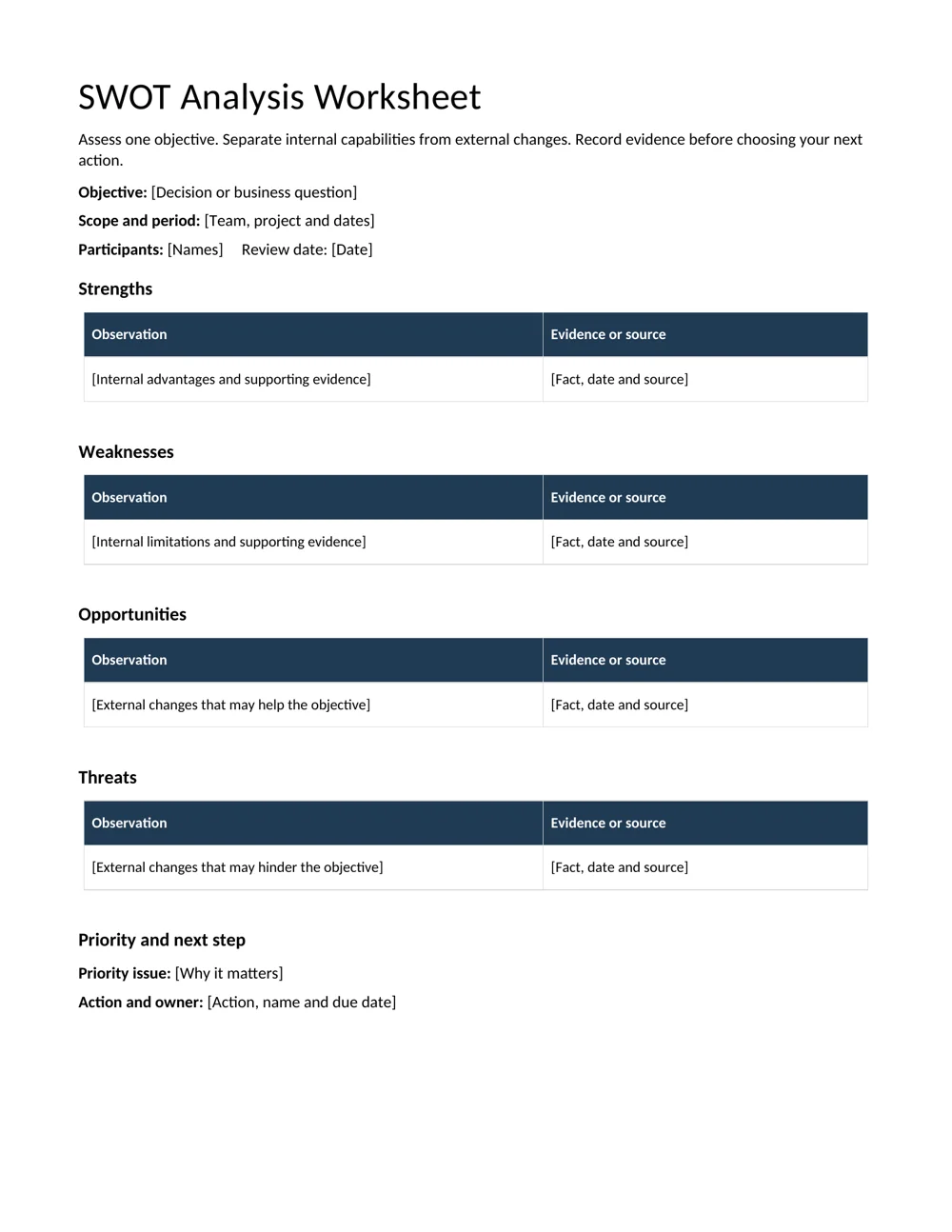
Strengths and weaknesses describe internal capabilities or limitations. Opportunities and threats describe external conditions that could help or hinder the objective. The same observation can have different implications for different objectives, so write the scope at the top before filling the worksheet.
- Strength: an experienced support team that can deliver the proposed service.
- Weakness: limited capacity to handle extra work during the busiest hours.
- Opportunity: customers asking for a service that the team does not currently offer.
- Threat: a competing service that could change customer expectations.
These are illustrative statements. Replace them with findings you can explain and check. A useful entry names the observation, why it matters to the objective, and the evidence behind it.
Run a focused review
- Set the decision. Describe the project, team or service and the time period being assessed. Avoid trying to review the entire organization in one short session.
- Collect observations. Ask participants to bring examples from operations, customer feedback, delivery records or other relevant information.
- Separate facts from assumptions. Add a date and source where possible. Label an untested idea as an assumption to investigate.
- Compare the entries. Combine duplicates, resolve vague wording and discuss disagreements before ranking the issues.
- Choose a few priorities. Focus on the findings most likely to affect the decision, rather than producing the longest possible list.
For a weakness such as repeat delivery errors, use a fishbone diagram to explore possible causes. The SWOT worksheet records the strategic issue; a cause analysis can help explain why it happens.
SWOT example for a small service team
Imagine a team considering a paid onboarding service. Its strength is staff who already explain the product clearly during support calls. Its weakness is that only one person currently maintains the training materials. An opportunity is repeated requests from new customers for structured help. A threat is another provider offering onboarding as part of a larger package.
The initial decision should not be “launch because we have strengths.” A more useful response is to test a small pilot, make a second person responsible for maintaining the materials, and gather feedback from a defined group of customers. The pilot reduces uncertainty about demand and delivery capacity before the team commits more resources.
Record what evidence would change the decision. For example, the team might review completion time, customer questions and staff workload after three pilot sessions. Those measures are more actionable than a general aim to improve service.
Turn the findings into a strategy action plan
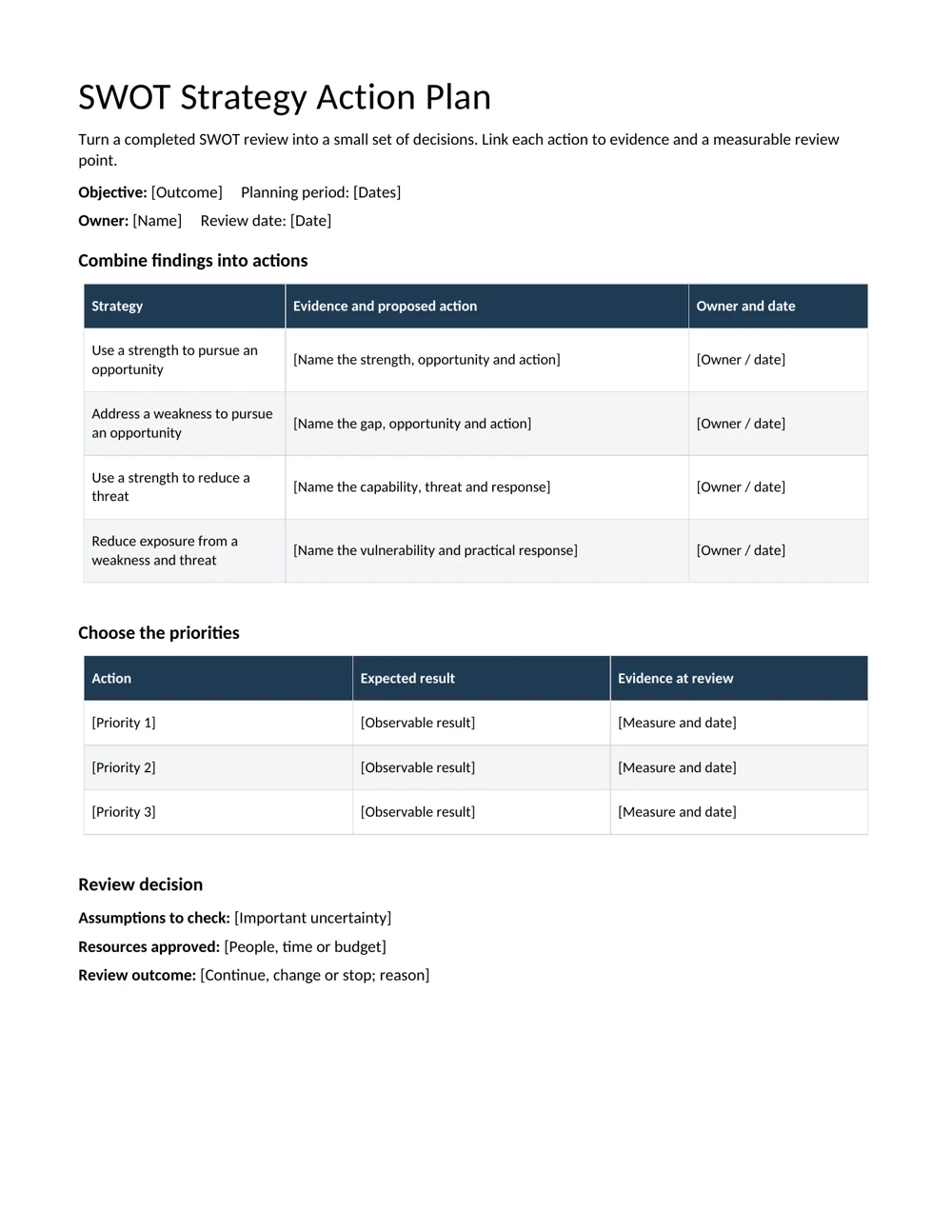
The second template connects the quadrants. Ask how a strength could help pursue an opportunity, how a weakness might prevent that opportunity, which strength could reduce a threat, and where a weakness increases exposure to a threat.
Then select a manageable set of actions. Each should include an owner, a due date and a result that can be observed at review. “Improve training” is too broad. “Create and test a reusable onboarding checklist with three pilot customers by the review date” gives the owner a clearer task.
If the work needs several steps, expand it using the action plan templates. Keep the strategic reason linked to the work so the team knows which finding the action addresses.
Common mistakes and how to avoid them
Do not list an action such as “hire a trainer” as an opportunity. Hiring is a possible response; the opportunity may be customer demand for training. Likewise, a plan to improve scheduling is different from the weakness of limited delivery capacity.
Avoid unsupported superlatives, such as “best team in the market.” Describe a capability you can demonstrate instead. Do not assume every external change is equally important, or that writing a threat down means it will happen.
Review the analysis when the objective, evidence or external conditions change. Use a monthly report format to track action outcomes if that fits your planning cycle. Keep earlier versions so you can see which assumptions proved useful and which needed revision.
Prepare a discussion that surfaces different evidence
Invite people who see different parts of the objective. A manager may know the resource constraints, while someone handling daily work may know where the process fails. A customer-facing colleague may bring a different view of demand. The aim is a more complete evidence base, not agreement with the most senior person in the room.
Give participants the question and scope before the session. Ask each person to bring a few observations with an example or source. During the first pass, collect those observations before debating every point. This helps prevent the opening discussion from using all the available time while quieter participants have not yet contributed.
When participants disagree, write the disagreement as a question that can be checked. For example, “customers will pay for onboarding” may be an assumption rather than an established opportunity. The next step could be a small customer conversation or pilot, with a named owner and a date for bringing the findings back.
Keep the language about the business issue rather than about personalities. “Only one person can update the materials” describes a continuity weakness. “The team is unhelpful” does not identify a capability, evidence or useful response. Rewrite judgments into observations the group can investigate and act on.
Prioritize findings without pretending the scores are facts
A long worksheet can make every point appear equally important. After collecting the findings, compare their likely effect on the stated objective, the evidence supporting them and how soon they could matter. A well-supported capacity constraint may deserve attention before an interesting but distant market possibility.
If the group uses scores, define the scale before applying it. For example, a simple discussion might distinguish a small, moderate or major effect and low, medium or high confidence in the evidence. The score is a way to structure judgment; it does not turn an uncertain observation into a measured prediction.
Look for dependencies between the findings. An attractive opportunity may depend on solving an internal weakness first. A strength may be valuable only while a particular external condition holds. Those connections are often more useful than comparing isolated entries in four boxes.
Choose a small number of priorities that the team can realistically address. Record why the selected issues matter and what has been deferred. This makes the decision easier to revisit later. Without that reasoning, a future reader may see the action list but have no idea why those actions were preferred over the other findings.
Make the next review a decision point
Write the review date when you assign the actions, not after they have become overdue. Decide what information the owner will bring and what decision the group expects to make. A review can ask whether to continue a pilot, change an approach, allocate more capacity or stop work that no longer supports the objective.
For the onboarding example, an owner might bring three completed session records, the staff time used and the recurring customer questions. Those observations can test both demand and delivery capacity. They are more informative than reporting that the action is “90 percent complete” without showing what was learned.
Keep changes to the original assumptions visible. If demand is weaker than expected, record that finding rather than rewriting the earlier opportunity as though the uncertainty never existed. A useful analysis preserves the reasoning that led to a decision and shows how later evidence changed it.
At the review, update the action plan and the analysis together where necessary. Close actions with a brief result, carry forward unresolved questions with an owner, and set another review only when it serves the decision. The worksheet should support a living planning process rather than become a document completed once and then ignored.
Download the 2 editable templates
Choose a file below. The preview shows the supplied layout; use the download link to open the editable document. Save a clean master before creating your completed copy.
SWOT analysis worksheet
Record internal strengths and weaknesses, external opportunities and threats, and evidence for the objective.
SWOT strategy action plan
Connect the findings to practical responses, owners, expected results and review dates.
Frequently Asked Questions
What does SWOT stand for?
SWOT stands for strengths, weaknesses, opportunities and threats. The first two examine internal factors; the second two examine external conditions relevant to the objective.
Which template should I complete first?
Start with the analysis worksheet to collect and prioritize findings. Use the strategy action plan afterward to assign responses, owners and review dates.
Can I use SWOT for an individual project?
Yes. Define the project decision and scope clearly, then assess the factors that affect that objective. A narrow project review can be easier to act on than an organization-wide list.
How many points belong in each section?
There is no required number. Include enough well-supported findings to explain the decision, then prioritize the few that matter most.
Does a completed SWOT decide the strategy?
No. It organizes observations and questions. You still need to test assumptions, compare options, decide on actions and review the results.

Leave a Reply
You must be logged in to post a comment.